Rome’s Water Wizards: Unearthing the Genius of Ancient Aqueduct Engineering
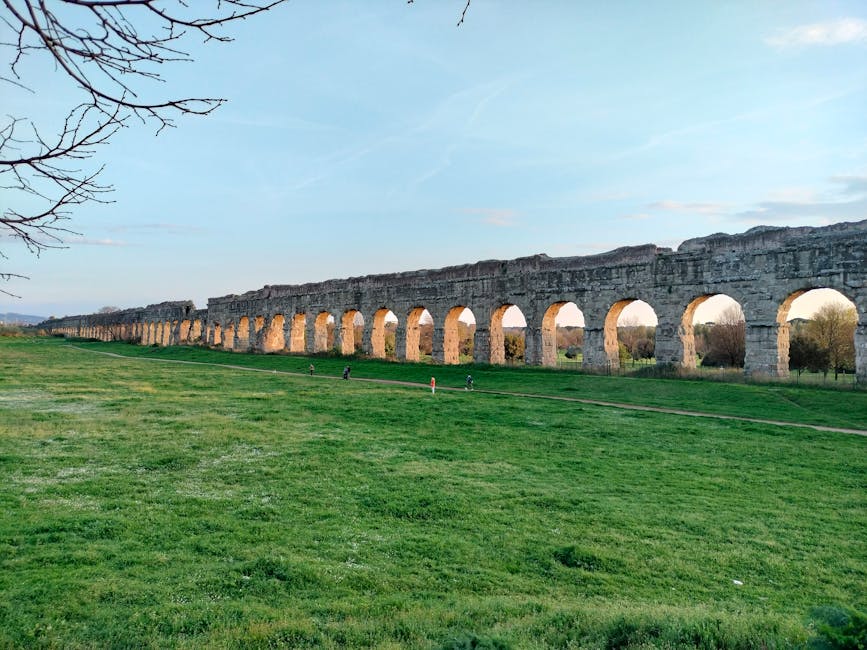
Journey to the Heart of Roman Engineering
Imagine standing in the bustling heart of ancient Rome, a city of millions. How did they manage to supply such a vast population with clean, running water? The answer lies in one of history’s most impressive feats of engineering: the Roman aqueducts. These monumental structures, stretching for miles across challenging terrain, are a testament to Roman ingenuity, a blend of mathematical precision, practical application, and sheer determination.
The Unseen Lifeline of an Empire
More than just impressive structures, aqueducts were the lifeblood of the Roman Empire. They delivered water for public baths, fountains, private homes, and industrial needs. The sheer scale and sophistication of these water systems allowed Roman civilization to thrive, supporting urban growth and promoting public health in ways previously unimaginable.
Table of Contents
- The Foundation: Planning and Surveying
- The Gradient: The Magic of Gravity
- Construction Techniques: More Than Just Stone
- The Case of Aqua Nova: A Hypothetical Challenge
- Maintenance and Innovation: Keeping the Water Flowing
- The Legacy: Ripples Through Time
- References
The Foundation: Planning and Surveying
Before a single stone was laid, meticulous planning and surveying were essential. Roman engineers employed sophisticated tools like the chorobates, a long, level bench with plumb bobs to ensure accurate horizontal gradients, and the groma, a cross-staff with plumb bobs to lay out right angles. They understood that even the slightest deviation could lead to insufficient flow or, worse, catastrophic flooding.
Understanding the Terrain
Their ability to read and understand the landscape was paramount. They would trace potential routes, considering elevation changes, geological stability, and the proximity of water sources. This painstaking process ensured that the aqueducts could function efficiently and durably over centuries.
The Gradient: The Magic of Gravity
The most fundamental principle behind Roman aqueduct engineering was gravity. The engineers designed their channels with an incredibly subtle, consistent gradient. This slight downward slope was enough to move water over vast distances without the need for pumps or complex machinery. This mastery of hydrostatics allowed them to transport water from distant hills and mountains right into the heart of cities.
A Gentle Descent
Typically, the gradient would be very shallow, often around 1:3,000 to 1:5,000, meaning a drop of just one meter for every three to five kilometers. This required immense precision to maintain over miles of construction. You can truly appreciate the dedication involved when you consider how hard it was to achieve such consistency in ancient times.
Construction Techniques: More Than Just Stone
Building these colossal structures was an undertaking of immense scale and required innovative construction methods.
Materials Matter
Roman engineers were masters of material science. They utilized local stone, volcanic pozzolana (a key ingredient in their durable concrete), and fired bricks. The concrete they developed was remarkably strong and water-resistant, allowing their structures to withstand the test of time and the elements. You’ll often see the distinctive opus caementicium used in their aqueduct construction.
Building Bridges and Tunnels
When faced with valleys, Romans built magnificent aqueduct bridges with multiple tiers of arches, like the iconic Pont du Gard. These not only carried the water channel but also served as vital transportation routes. For hills and mountains, they excavated tunnels, using the same precise gradient calculations. These tunnels were vital to maintaining the steady flow of water, showcasing their adaptability to diverse geographical challenges.
The Case of Aqua Nova: A Hypothetical Challenge
Let’s imagine the fictional Aqua Nova project, tasked with supplying water to a rapidly growing Roman provincial town situated in a hilly region, several miles from a reliable mountain spring. The primary challenge was a deep, winding gorge that lay directly in the path of the most direct route.
The Scenario: The spring was located 20 miles away, at an elevation 50 meters higher than the town’s distribution point. The gorge was 500 meters wide and 150 meters deep. A direct channel across the gorge was impossible due to the steep descent and the need to maintain the subtle gradient.
The Challenge: The engineers had to find a way to cross the gorge while ensuring the water maintained its crucial downward slope. Building a single, enormous bridge 150 meters high was deemed too expensive and structurally risky given the terrain.
The Resolution: The Roman engineers for Aqua Nova devised a multi-tiered solution. First, they constructed a substantial bridge across the narrower, shallower parts of the gorge, carrying a single-level aqueduct. For the deepest section, they opted for a more economical approach: building a smaller, but still impressive, two-tiered bridge that spanned the widest part. This bridge was carefully engineered to maintain the gradient. Crucially, they also excavated a short, well-ventilated tunnel through a rocky outcrop on the far side of the gorge to precisely align the aqueduct and overcome a sudden elevation change. The total length of the aqueduct was extended to 25 miles to accommodate the winding path and the necessary gradient adjustments around the gorge, showcasing their commitment to precision over expediency.
Maintenance and Innovation: Keeping the Water Flowing
Roman aqueducts weren’t static marvels; they required ongoing maintenance. Teams of workers, known as aquarii, were responsible for inspecting, cleaning, and repairing the channels. They cleared blockages, repaired cracks, and ensured the integrity of the system. Over time, Romans also innovated, improving the concrete mix and developing more efficient surveying techniques.
The Legacy: Ripples Through Time
The impact of Roman aqueduct engineering cannot be overstated. They not only transformed urban life in the Roman world but also influenced subsequent engineering practices for centuries. Many aqueduct structures, or parts of them, still stand today, a powerful reminder of the incredible capabilities of these ancient builders. When you see these remnants, consider the immense planning, labor, and scientific understanding that went into creating them – a true marvel that you can still witness firsthand.
References
- Smithsonian Magazine: Roman Aqueducts
- Britannica: Aqueduct
- Journal of Roman Archaeology: The Hydraulics of Roman Aqueducts
- MIT Technology Review: The Engineering Marvels of Ancient Rome
- National Geographic: Ancient Engineering
- History.com: Roman Engineering
Featured image by lorenzo marino on Pexels